|
Bottlenecks, Causes and Possible Solutions of Municipal Wastewater Treatment in China
Industry News | Shengjian Environmental Technology (Wuhan) Co., Ltd. Abstract: Since the 1990s, China has made remarkable progress in urban sanitation: extensive wastewater and sewage treatment infrastructure has been established, the urban wastewater treatment rate has reached 94.5%, and nutrient removal from wastewater has been implemented nationwide in accordance with the law. However, municipal wastewater treatment plants still face problems stemming from the unique characteristics of wastewater quality. This study compared China with other countries with a longer history of wastewater and sewage treatment in terms of energy recovery, nutrient removal and sludge production in municipal wastewater treatment, revealed the characteristics of China's wastewater - namely high inorganic suspended solids (ISS) concentration, low COD concentration and low carbon-to-nitrogen ratio (C/N) - and the causal relationship between these characteristics and the performance of municipal wastewater treatment plants. It further proposes that the design and operation of municipal wastewater treatment plants should take local wastewater quality characteristics into account, provides cost-effective measures and solutions for improving the sustainability of municipal wastewater treatment, assesses the potential benefits of implementing these measures, and underscores the need to strengthen results-oriented applied research on municipal wastewater treatment. Introduction Since the 1990s, China has made remarkable progress in urban sanitation. In 2017, municipal wastewater treatment capacity reached 49.2 x10⁹m³, with a coverage treatment rate of 94.5% in urban areas. Nutrient removal (nitrogen and phosphorus) has been implemented nationwide in accordance with the law. However, many municipal wastewater treatment plants face problems such as very little energy recovery, high costs of nitrogen and phosphorus removal, and high sludge production. The unique characteristics of China's sewage/wastewater, caused by leakage from the sewer network system, are the main reason for the low efficiency of municipal wastewater treatment plants. Recently, three Chinese ministries promulgated a document entitled "Three-Year Action Plan for Improving the Quality and Efficiency of Urban Wastewater Treatment (2019-2021)," emphasizing the critical role of sewer network rehabilitation in urban environmental sanitation and ecological functions and marking a turning point in China's urban environmental sanitation strategy. Given the arduous tasks, huge investment and long cycle involved in sewer network rehabilitation, cost-effective and rapid actions and measures must be taken to improve the efficiency and sustainability of municipal wastewater treatment in China. This study has three objectives: (1) to compare the differences in energy recovery, nutrient removal and sludge production between municipal wastewater treatment plants in China and other countries with a longer history of sewage/wastewater treatment; (2) to reveal the causal relationships between wastewater characteristics and process performance in municipal wastewater treatment plants; (3) to propose cost-effective measures and solutions suited to China's wastewater quality characteristics so as to improve the sustainability of municipal wastewater treatment plants. Methods Wastewater treatment plants in China, Europe, the United States and Singapore all recover energy through anaerobic digestion (AD) combined with combined heat and power (CHP) (hereinafter referred to as AD-CHP), based on the use of anaerobic digestion (AD) and combined heat and power (CHP). A considerable proportion of plants in China omit primary sludge settling (PS), and very few plants use sludge anaerobic digestion (AD); sludge production is estimated mainly from observed biological yield (coefficients) and the accumulation of influent inorganic suspended solids (ISS). Results and Discussion Municipal Wastewater Treatment - Sustainability Table 1 shows that less than 5% of China's municipal wastewater treatment plants use sludge anaerobic digestion, a proportion that is very low compared with Europe, the United States and Singapore. Although countries with a longer history of wastewater treatment applied AD-CHP technology widely long ago, in China energy recovery through sludge anaerobic digestion and combined heat and power (hereinafter AD-CHP) is very limited. Abandoning sludge anaerobic digestion not only causes problems of sludge stabilization and leads to secondary pollution and hygiene issues, but also - because there is no destruction of VSS in sludge anaerobic digestion, combined with the addition of lime for conditioning and filter-press dewatering - increases the sludge volume, making sludge treatment, disposal and reuse more difficult. 
To meet stringent nutrient discharge standards [such as China's Class 1A discharge standard for municipal wastewater treatment plants, TN (total nitrogen) <15 mg-N/L, TP (total phosphorus) < 0.5 mg-P/L, and TN <10 mg-N/L and TP <0.3 mg-P/L implemented in sensitive areas of some provinces], many Chinese wastewater treatment plants still need to add external carbon sources for nitrogen (and phosphorus) removal, even though primary sludge settling is not provided. Fundamentally, this is attributed to the low C/N ratio of the influent, since for typical wastewater conventional biological nitrogen removal processes can achieve effluent TN <10-15 mg-N/L with no or only small additions of carbon. Today, in some plants chemical costs are second only to electricity. If stricter nutrient discharge standards are enforced (for example TN <5 mg-N/L and TP < 0.1 mg-P/L), this will bring further economic burdens to plant operation and local authorities; moreover, considering primary energy use and the associated greenhouse gas emissions, excessive chemical addition is also environmentally unsustainable. The activated sludge in wastewater treatment plants consists of microorganisms, refractory particles and inorganic suspended solids (ISS); its production and composition depend on the wastewater quality characteristics, the treatment process and the site environment. Table 2 lists the annual average sludge production (dry solids, DS) calculated on the basis of COD removal for municipal wastewater treatment in China in 2015, 2016 and 2017. The three-year average is 0.69 kg per kg COD removed. Given that only 10%-20% of plants use primary sludge settling and less than 5% use sludge anaerobic digestion, the sludge production per kg of chemical oxygen demand removed can be regarded as the apparent yield (coefficient) Yob as defined for the activated sludge process. Using the average composition of municipal wastewater in China in 2017, assuming an influent VSS/TSS ratio of 80%, biological nitrogen and phosphorus removal processes with auxiliary chemical phosphorus removal (molar Fe/P removal ratio of 1.5, removing 80% of P), a readily biodegradable COD (RBCOD) fraction of 8%, a BOD/P of 18% and a sludge retention time (SRT) of 18 days, a sludge yield of 0.48 kg per kg COD removed was calculated according to the method proposed by Paul et al. (2001). This is 30% higher than the 0.37 kg per kg COD removed of conventional biological nutrient removal (BNR). The reason is the increase in chemical sludge caused by the metal salts added for chemical phosphorus removal. The above-mentioned three-year average sludge yield of 0.69 kg per kg COD removed for Chinese municipal wastewater plants (see Table 2) is about 44% higher than the theoretical estimate of 0.48 kg per kg COD removed under a normal influent VSS/TSS ratio of 80%. Surveys of some wastewater treatment plants in China show that when the influent characteristics are roughly normal, the sludge yield is close to 0.48 kg per kg COD removed, whereas when the influent characteristics are abnormal, the sludge yield is close to 0.69 or even higher. The analysis suggests that the high sludge yield coefficient originates largely from the high concentration of inorganic suspended particles in the influent. In France, 39% of wastewater treatment plants have sludge anaerobic digestion (Table 1), with an average sludge yield of 0.44 kg per kg COD removed. Singapore's sludge yield is only 0.24 kg/kg COD, one third of China's; all municipal wastewater treatment plants in Singapore use sludge anaerobic digestion for energy recovery, reducing solids by about 35%. Comparing the sludge yields of France and Singapore shows that the sludge yield coefficient of China's current municipal wastewater plants is indeed too high. 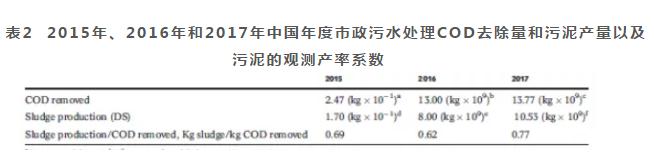
a COD removal, kg x 10 -1 /m3, average value for municipal wastewater treatment plants (CUWA 2016). b COD removed, kg x 10 9, total for all municipal wastewater treatment plants (CUWA 2017). c Total COTP removed, kg x 10 9, total for all wastewater treatment plants (CUWA 2018). d Sludge production (DS), kg x 10 -1 /m3, average value for municipal wastewater treatment plants (CUWA 2016). e Sludge produced (DS), kg x 10 9, total for all municipal wastewater treatment plants (CUWA 2017). f Sludge production (DS), kg x 10 9, total for all municipal wastewater treatment plants (CUWA 2018). Reasons for Low Performance: Unique Wastewater Quality Characteristics Wastewater quality characteristics are crucial to the design of activated sludge and the overall plant process. An earlier study estimating leakage ratios for sewer systems in China and three of its cities showed that leakage from sewer systems gives Chinese municipal wastewater three basic characteristics: high inorganic suspended solids concentration (ISS), low COD and low C/N ratio. Although more data are needed to describe the national situation, preliminary investigations show that in China, even in sewer systems with good construction quality and proper management and maintenance, the influent VSS/TSS ratio at some plants is in the range of 50%-70%, lower than the normal range of 60%-80%. Literature reports of a low influent COD/SS ratio (<1) and BOD5/SS ratio (0.3-0.5) reflect wastewater containing high ISS (sand, silt and clay, etc.), indicating a marked "inorganic" character of the influent at domestic plants. As shown in Equation (1), assuming no primary settling and no ISS in the final effluent, the influent ISS/TSS ratio directly affects the mixed liquor inorganic suspended solids (MLISS) concentration. MLISS = ISSIO x(τ/Θc) (1) where ISSIO: influent ISS; Θc: sludge retention time SRT; τ: hydraulic retention time. For an activated sludge process without primary settling, with 12 days SRT and 0.5 days HRT, influent VSS of 180 mg/L and ISS of 79 mg/L [VSS ratio of 70% [180/(79+180)]], when the influent VSS ratio decreases by 10% (ISS increases to 120 mg/L), using Equation (1) the mixed liquor ISS increases by about 1,000 mg-ISS/L, indicating the sensitivity of the mixed liquor MLVSS/MLSS fraction to influent ISS. Simulations show that when the influent ISS/TSS increases (VSS/TSS ratio decreases) by 10%, the MLVSS/MLSS fraction can decrease by about 10% (see Figure 1). In the activated sludge of most Chinese wastewater treatment plants (and in the feed to sludge anaerobic digesters), the MLVSS/MLSS ratio is in the range of 30% to 60%. A lower MLVSS/MLSS ratio usually results from high influent ISS concentrations at plants connected to sewer systems with relatively serious leakage, whereas a relatively higher MLVSS/MLSS ratio usually comes from Chinese northern plants connected to well-maintained sewer systems or sewer systems with exfiltrative leakage, whose influent ISS is lower. Recent reports show that the average volatile solids fraction of activated sludge mixed liquor in Chinese plants is below 50%, far below the normal range of 70%-75%, indicating a significant effect of the accumulation of high concentrations of inorganic solids (ISS) in the influent in activated sludge systems, even when accounting for the accumulation of chemical sludge and minerals formed by chemical phosphorus removal (volatile solids fraction of 60%). A low mixed liquor MLVSS/MLSS ratio has multiple adverse effects on process performance and operation in municipal wastewater treatment plants. Taking an activated sludge solids content of 70% as the comparison baseline, to retain the same amount of biomass in the reactor, a lower MLVSS/MLSS of 50% means the aeration tank volume must increase by about 30%. In addition, the increase of inorganic particles in the mixed liquor reduces the content of active microorganisms per unit volume. Its effect is similar to neglecting high influent ISS in design; both affect biochemical process performance, for example insufficient sludge age for nitrification at low water temperature leading to high effluent ammonia nitrogen in winter. Similar to activated sludge, a low volatile solids content in the feed to sludge anaerobic digesters reduces the biogas yield per unit effective volume (or per unit of sludge) and decreases biogas production. To achieve a predetermined VSS reduction rate and gas production rate, additional volume or a longer SRT is required. Reduced biogas production, together with the deposition of solids such as sand in anaerobic digesters and the material wear and pipe clogging caused by sand, largely limits the application of sludge anaerobic digestion in China. The high ISS content in wastewater is considered the main technical obstacle to applying sludge anaerobic digestion in China. The accumulation of influent ISS in primary and secondary sludge leads to increased sludge production. Simulations show that, with or without primary settling, over an influent VSS/TSS range of 35%-75%, for every 10% decrease in the influent VSS/TSS ratio the (excess) sludge production (DS) decreases by 20%-30% (see Figure 1). Related to the sludge increase, the marked increase in excess sludge caused by high ISS requires additional surface area (capacity) in secondary clarifiers and capacity in solids-handling facilities (such as dewatering and pumping), as well as energy for handling solids, greatly increasing the investment required for solids treatment in municipal wastewater plants. In summary, the high ISS in today's wastewater causes a variety of adverse effects on the performance and operation of Chinese municipal wastewater treatment plants and greatly affects their sustainability. 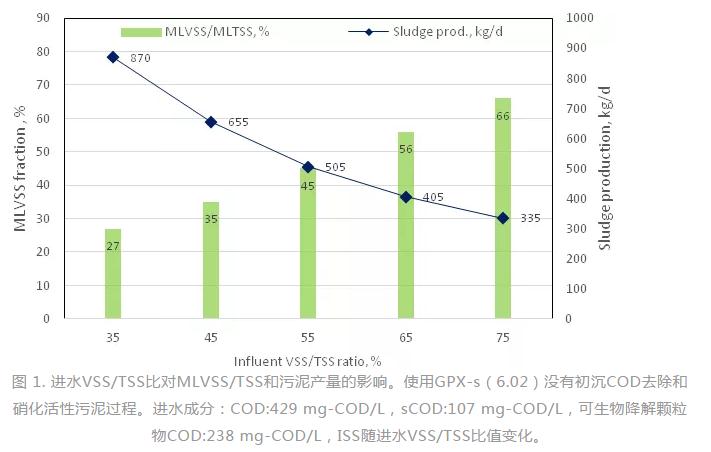
In 2016, the average influent COD concentration of China's municipal wastewater treatment plants was only 267 mg-COD/L, about half of the influent concentration of plants in the countries listed in Table 3. This is attributed to in-sewer biodegradation and a high leakage ratio. The influent suspended solids (SS) concentration at many plants is in the range of 100 mg/L, about 150 mg/L lower than typical wastewater values; sedimentation and accumulation of particles in the sewer may be one of the reasons. 
Low influent COD leads to a low biomass (MLVSS) concentration in the aeration tank. The higher the influent ISS, the higher the non-volatile solids fraction and sludge production per unit of COD removed in the mixed liquor. This makes efficient grit removal especially critical when treating low-COD influent. It should be noted here that a low influent COD concentration does not mean sludge anaerobic digestion must be abandoned (see below), although the amount of energy recovered may be affected compared with higher influent COD. The influent C/N ratio of Chinese urban wastewater treatment plants ranges from 5.4 to 10.9; the influent C/N ratios of plants in Beijing, Shanghai and Guangzhou range from 7.5 (Guangzhou) to 8.8 (Beijing), averaging 8.0, below the typical range of 8 to 12 elsewhere. A low C/N ratio leads to carbon shortage, especially when high-rate biological nitrogen removal is required. In addition, given the potentially high concentration of inert particulate chemical oxygen demand, denitrification efficiency and biological phosphorus removal efficiency may be further reduced compared with activated sludge treating typical wastewater with similar influent but a lower proportion of inert particulate COD. At many wastewater treatment plants in China, primary settling tanks have been omitted in order to increase the carbon supply and improve the efficiency of biological nitrogen removal (denitrification), because the influent COD is low. Considering that primary settling removes 30%-40% of influent COD, omitting primary settling increases the biological tank volume by about 40% and requires a significant increase in the surface area of secondary clarifiers as well, leading to larger facilities and longer hydraulic retention times and thus higher construction costs. Moreover, with more biodegradable particulate COD introduced, the hydrolysis rate of particles becomes the determining factor for improving denitrification efficiency; owing to the relationship between hydrolysis and temperature, an improvement in denitrification efficiency is possible in summer but not necessarily in winter. Therefore, the purpose of omitting primary settling may not necessarily be achievable. Comprehensive and detailed analysis of wastewater characteristics, measurement of nitrate reduction rates at different temperature ranges, and designs with flexible operational strategies are required. On the other hand, to meet increasingly stringent nutrient discharge standards (for example TN <10 mg-N/L), the addition of external carbon sources is being increasingly practiced. A rough estimate at current market prices indicates that a 100,000 m³/d wastewater treatment plant spends about RMB 3 million (approximately USD 450,000) per year to purchase acetate (HAc) equivalent to 20 mg-HAc/L. Purchasing carbon and chemical substances is becoming a heavy burden on plant operation. Potential Solutions Considering Wastewater Quality Characteristics in the Design and Operation of Municipal Wastewater Treatment Plants Faced with China's unique wastewater quality characteristics, the design and operation of wastewater treatment plants must comprehensively consider local wastewater quality characteristics, discharge requirements, geographic location, treatment capacity, and the costs of energy supply, chemicals and sludge disposal. Wastewater quality characteristics play a crucial role in process selection and design. Conventional biological processes may not be suitable for treating low-COD influent (for example COD <100 mg-COD/L) in some parts of southern China, whereas technologies based on membrane separation or SANI (sulfate reduction, autotrophic denitrification and nitrification) may be appropriate. Omitting primary settling and using biodegradable particulate COD to improve denitrification efficiency may be feasible in warm climates but not necessarily in cold regions. Energy recovery should receive sufficient attention on the agenda of municipal wastewater treatment plants. As early as the turn of the century in the United States, based on economic feasibility, many plants with capacities around or above 100,000 m³/d used sludge anaerobic digestion. Recent data show that even plants with capacities of 20,000-40,000 m³/d can still be economically favorable using sludge anaerobic digestion. European data show that plants with capacities around or above 10,000 m³/d (50,000 PE) are economically viable using sludge anaerobic digestion. Conditions in China differ from those in the United States and Europe; the urgency of studying the economic feasibility and necessity of applying sludge anaerobic digestion to municipal wastewater treatment plants under local conditions and factors is evident, including a balance between energy recovery and nutrient removal and a cost-benefit analysis. Recommended Measures Given the long time required for sewer network rehabilitation and the current widespread condition of municipal wastewater treatment plants, cost-effective measures and solutions need to be identified and implemented, along with the formulation of design and operation guidelines that integrate all relevant factors, so as to improve plant performance. The following will discuss improvements to grit chambers, sludge fermentation, and the application of sludge anaerobic digestion and heat and power recovery. Considering the numerous benefits and limited costs, it is worthwhile for all plants, regardless of size, to improve grit removal efficiency, while sludge fermentation, sludge anaerobic digestion and combined heat and power may be suitable for plants with relatively large capacity and relatively high influent COD concentration. Enhancing the grit removal efficiency of grit chambers. From the above discussion it is evident that the low volatile solids fraction of the mixed liquor and the high sludge production are attributable to: i. In many cases, the design of grit removal units has technical flaws, such as insufficient (underestimated) retention time and a lack of necessary maintenance during operation. ii. In many parts of China, the ISS concentration in wastewater is high and contains a considerable fraction of fine inorganic solids with diameters far smaller than 200 micrometers (which are difficult to remove by conventional grit removal units). Recommended measures include: Investigate the performance of existing grit removal units, including ISS solids loading and removal efficiency, and carry out regular maintenance. In addition, upgrade or retrofit existing conventional grit removal equipment, for example by increasing hydraulic retention time to improve efficiency. Some examples show that after simple upgrades, improved performance of conventional grit removal units can raise the MLVSS/MLSS of the biological tank mixed liquor to 55%-60%. In short, on-site investigations to carefully evaluate the removal efficiency of grit facilities for particles smaller than 200 micrometers are highly necessary. Considering the widespread occurrence of high concentrations of fine inorganic solids (ISS) in Chinese wastewater and the negative effects of ISS on the operating performance of many plants, there is an urgent need in China for research or equipment development on influent grit removal, especially efficient ISS removal technologies. Based on the above analysis, the following recommendations are offered for improving the operational performance of grit removal processes in Chinese wastewater treatment plants: i. Conduct extensive surveys of the volatile solids fraction in wastewater and mixed liquor at municipal wastewater treatment plants; measure and estimate the grit removal performance of different types of grit removal processes, especially the removal efficiency of grit particles below 200 micrometers; ii. Reduce ISS accumulation in the process by improving the efficiency of grit removal units: increasing grit removal efficiency can raise the volatile solids fraction of the mixed liquor by about 10%, with the potential to increase the volatile solids fraction to 55%-60% in small plants and to 60%-65% in medium and large plants (≥50,000 m³/d), Sludge fermentation. Maximizing the use of the COD contained in wastewater should be the primary approach to addressing the carbon shortage in biological nitrogen and phosphorus removal processes. For full utilization of readily biodegradable soluble COD, the Zurich wastewater treatment plant can serve as a reference. For full utilization of biodegradable particulate COD, primary sludge fermentation is a widely used technology. Figure 2 shows data on primary sludge fermentation at a full-scale wastewater plant in China; from feed to effluent, an average increase of 40 mg-VFA/L of volatile fatty acids (VFA) was observed. Meanwhile, the use of return activated sludge (and on-line mixed liquor) fermentation technology to improve nitrogen and phosphorus removal has been widely applied in Denmark, Sweden, the United States and other European countries. China already has engineering examples of primary sludge and activated sludge fermentation, but there is a lack of long-term successful operation reports, which has affected the wider application of sludge fermentation technology; this may be due to insufficient long-term follow-up studies of these sludge fermentation projects in China. 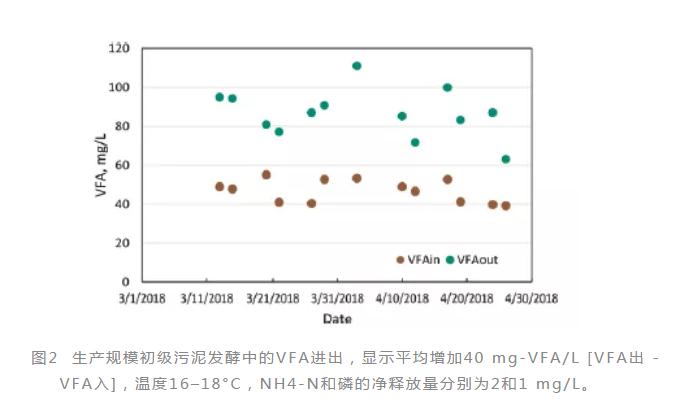
Nutrient removal processes with low carbon requirements. Processes that can remove nutrients under low-carbon conditions, such as BCFS (biological chemical phosphorus and nitrogen removal), SANI (integrated sulfate reduction, autotrophic denitrification and nitrification) and MABR (membrane aerated biofilm reactor), may be considered. BCFS and MABR have been applied at full scale in the industry, while SANI is at pilot scale and still awaits verification at engineering scale. In addition, the mainstream anammox phenomenon observed at Xi'an No. 4 Wastewater Treatment Plant also deserves further attention and study. The Future Increasing energy recovery. For wastewater treatment plants with appropriate capacity and relatively high influent COD concentrations (for example > 300 mg/L), the volatile solids fraction of the sludge mixed liquor (MLVSS/MLSS ratio) is the key to applying sludge anaerobic digestion. Calculations show that if the mixed liquor MLVSS/MLSS is raised from 55% to 65% - only a 10% increase in volatile solids - the biogas yield can increase by 20%. Raising the volatile solids fraction also effectively increases the sludge activity in the biological tank, improves tank volume utilization efficiency, and at the same time significantly reduces metal material wear and pipe clogging, largely removing the technical obstacles to applying sludge anaerobic digestion. Electricity recovered from sludge anaerobic digestion through combined heat and power can save about 30% of the electricity used to operate a wastewater treatment plant. The Shanghai Bailonggang Wastewater Treatment Plant (capacity 2,000,000 m³/d) has an influent COD of 250 mg/L, and the effluent COD after primary settling at the Zurich wastewater treatment plant is about 250 mg/L; both plants use sludge anaerobic digestion for energy recovery. For Chinese plants with capacities above 100,000 m³/d, even if only half applied sludge anaerobic digestion for energy recovery, the operational benefits and environmental sustainability of wastewater treatment would be greatly improved. For smaller plants, dewatered sludge could be combined and sent to large sludge facilities or regional sludge treatment centers for energy recovery. Reducing carbon expenditure. The target is to obtain a net 25 mg-COD/L through sludge fermentation. This is equivalent to reducing the final effluent nitrate nitrogen concentration by about 5 mg-N/L, helping to achieve an effluent total nitrogen concentration of less than 10 mg-N/L with little or no carbon addition. Reducing sludge volume. By improving influent grit removal and increasing the influent VSS/TSS fraction by 10%, sludge production can be reduced by about 20%. Combined with the removal of about 40% of VSS through sludge anaerobic digestion (Grady et al., 1999), sludge volume reduction can reach about 50%. This means that if ISS reduction and sludge anaerobic digestion were implemented at about half of the wastewater treatment plants, national sludge production could be reduced by about 25%. Together with increased energy recovery and reduced chemical purchase costs, implementing ISS reduction and sludge anaerobic digestion would greatly improve the sustainability of wastewater treatment plants. Strengthening results-oriented applied research. Vigorous efforts should be made to strengthen sustainable research and technology development aimed at overcoming or solving the technical bottlenecks posed by China's wastewater quality characteristics and achieving the goal of efficient wastewater treatment. A detailed feasibility study plan should be drawn up from the outset; research and actual testing targeted at wastewater characteristics - especially influent ISS - and nitrate reduction rates will help determine technically whether primary settling tanks are needed. Indicator tests such as the biochemical volatile fatty acid potential (BVFAP) can be used to assess the feasibility of primary sludge and activated sludge fermentation. At present, research on wastewater plant design under actual water quality conditions and on the practical problems of municipal wastewater treatment associated with China's unique wastewater quality remains relatively weak. In recent years China has made outstanding progress in water science research, and now is the right time to further strengthen research in the applied field of sustainable municipal wastewater/sewage treatment. Concluding Remarks Since the 1990s, China has made remarkable progress in urban sanitation engineering. However, municipal wastewater treatment still faces problems of inefficient energy recovery, high nutrient removal costs and high sludge production. These difficulties stem from the unique wastewater quality characteristics: high ISS, low COD and low C/N ratio. This study has revealed the causal relationship between wastewater quality characteristics and the low efficiency of municipal wastewater treatment plants. It further recommends that the design and operation of wastewater treatment plants be based on actual local water quality characteristics. Given that sewer network improvement takes a certain period, sustainability improvements at treatment plants can proceed in parallel with efforts to improve the quality and efficiency of the network and rehabilitate the pipes. Cost-effective measures and solutions are proposed - namely high-efficiency grit removal, sludge fermentation and the application of low-carbon biological nitrogen and phosphorus removal processes - and the potential benefits of implementation are estimated. The need to strengthen results-oriented applied research on municipal wastewater treatment in the future is emphasized. Acknowledgements Yang Xiangping (China Urban Water Association), Zhang Yue (China Water Industry Association), Zheng Xingcan (North China Municipal Engineering Design and Research Institute Co., Ltd.), Gan Yiping (China Urban Water Supply and Drainage Association), Wang Hongchen (Renmin University of China), Wang Jiawei (Beijing Drainage Group), Hu Weijie (Shanghai Municipal Engineering Design Institute (Group) Co., Ltd.), Wu Yuanyuan (Beijing Capital Group), Yang Anming (Beijing Drainage Group), Li Jinhe (Tianjin Capital Environmental Protection), Ding Yongwei (Suzhou Water Group Co., Ltd.), Li Ji (Jiangnan University), Wang Yan (Jiangnan University) and Lv Zhen (Changzhou Drainage Management Office), among others, provided useful information and insights.
|