|
Development Trends of the Wastewater Treatment Membrane Industry
Industry News | Shengjian Environmental Technology (Wuhan) Co., Ltd. In recent years, local standards have been successively introduced in Beijing, Tianjin, Shanxi, the Chaohu Lake basin, the Taihu Lake region, the Daqing River area, and other places. In some sensitive areas, wastewater discharge standards have risen from the former Class IA to quasi-Class IV, or even Class III. To cope with ever-tightening water quality standards, a variety of combined membrane technology processes will be increasingly applied. Among them, multiple membrane combination processes represented by the dual-membrane method can give full play to the advantages of each technology, offset the shortcomings of using them individually, and enable advanced wastewater treatment and reclamation, representing a new direction for future development. 01 Membrane Classification and Characteristics A membrane is a thin-layer material with selective permeability that can, in a specific form, restrict and promote the migration of various substances in the fluids on either side. Membrane separation is a process that uses external energy or a chemical potential difference as the driving force and exploits the selective permeability of the separation membrane to separate, purify, and concentrate different substances in a mixture. ◆ Classified by membrane material, membranes can be divided into organic membranes (organic polymers) and inorganic membranes (metal membranes, ceramic membranes, glass membranes, etc.). Organic membranes are easy to prepare and low in cost, while inorganic membranes have good heat resistance and chemical stability, outstanding mechanical properties, microbial resistance, and a long service life, but are difficult to form and costly. ◆ Classified by separation mechanism, membranes can be divided into porous membranes that use the sieving mechanism (i.e., separation based on pollutant size) and non-porous dense membranes that use the diffusion principle (i.e., separation based on the osmotic pressure of the solution); non-porous dense membranes are also called diffusion membranes. Porous membranes have fixed pores and include microfiltration, ultrafiltration, and nanofiltration membranes. Based on pore size they can be divided into macropores (pore size >50nm), mesopores (pore size range 2-50nm), and micropores (pore size <2nm). Non-porous dense membranes include nanofiltration and reverse osmosis membranes. In terms of membrane morphology, ultrafiltration and microfiltration currently mostly use hollow-fiber membranes, while reverse osmosis and nanofiltration mostly use spiral-wound membranes. Membrane Processes and Their Characteristics 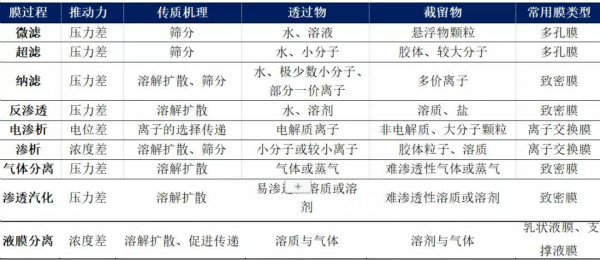
Source: Fundamentals of the Application of Membrane Separation Materials 02 Membrane Industry Output Value The past 20 years have been a period of rapid growth for China's membrane industry. Over these 20 years, the total output value of the global membrane industry (including membrane elements, membrane modules, membrane equipment, membrane engineering, etc.) has grown steadily. By the end of 2017, the global membrane output value had reached USD 105 billion, while the total output value of China's membrane industry was about RMB 200 billion. China's share of global membrane industry output value rose from 1.7% in 1999 to over 27% in 2017. In terms of structure, with the year-on-year increase in demand for seawater desalination, brackish water softening, ultrapure water preparation, and the removal of trace pollutants, the share of reverse osmosis membranes in the membrane market has also grown, with the global RO membrane sales share rising from 48.4% in 2005 to 55.3% in 2013. At the same time, the market share of UF/MF membranes has declined. In the future, as the application of membrane technology in industrial wastewater, municipal wastewater, municipal drinking water, household water purification, and other fields increases, the membrane industry will continue to develop rapidly. Compared with RO membranes, NF membranes have properties between ultrafiltration and reverse osmosis, with advantages such as low operating pressure, low operating cost, high flux, and selective retention of polar small molecules, so their application share is expected to rise in the future. 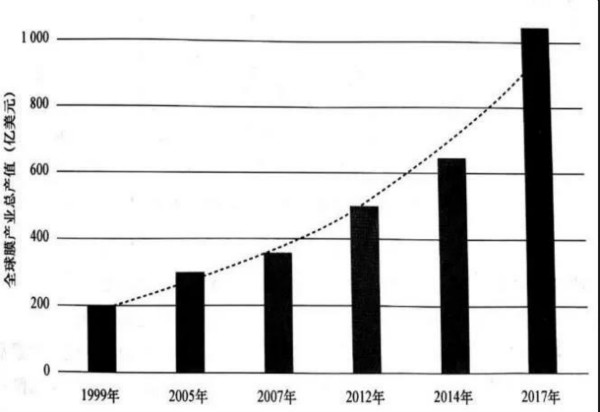
Growth of Global Membrane Industry Output Value 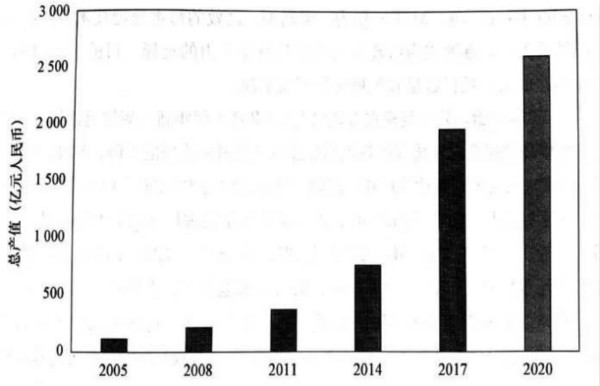
Growth of China's Membrane Industry Output Value 03 Separation Membrane Performance and Technology The performance of a separation membrane is determined by the membrane material and the membrane-making process conditions. The relevant performance indicators of membrane products fall mainly into three categories: separation and permeation performance, physical properties, and chemical properties. ◆ Separation and permeation performance includes: water production, water flux, pure water permeability, molecular weight cut-off, rejection rate, salt rejection, recovery rate, maximum pore size, average pore size, pore size distribution, porosity, air tightness, and integrity. ◆ The physical properties of membranes include: structural properties (appearance, membrane area, membrane thickness, inner and outer diameter of membrane fibers), mechanical properties (tensile strength, burst strength, bending strength, flexibility index, elongation at break), electrical properties (charge, Zeta potential), hydrophilicity, and heat resistance (maximum operating temperature). ◆ The chemical properties of membranes include: chemical stability (chemical compatibility), oxidation resistance (short-term residual chlorine tolerance limit, hydrogen peroxide tolerance limit), acid and alkali resistance (operating and cleaning pH range), and fouling resistance. The different properties of membranes constrain one another; in practical applications, the economics of the membrane and the specific requirements of the environmental project should be considered comprehensively to select a separation membrane with suitable performance. 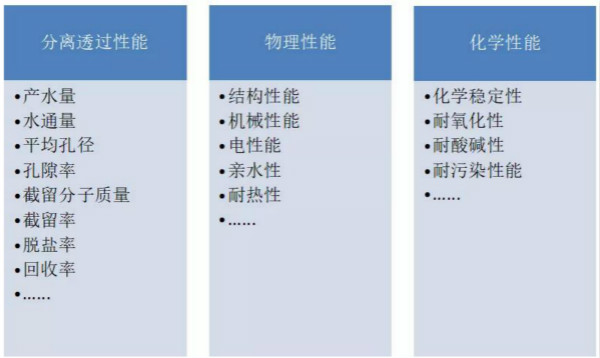
Performance Indicators for Judging Membrane Quality Therefore, the technical difficulties of membrane materials lie mainly in the research and development of membrane materials and in the selection and process control of membrane preparation techniques. In particular, the membrane preparation process is very important to the performance of separation membranes: with the same material, performance can vary greatly due to different manufacturing processes and control conditions. Taking the non-solvent induced phase separation (NIPS) process as an example, the membrane manufacturing process can be roughly divided into six stages: 1) Dissolve the polymer material in a solvent, add additives, and prepare the casting solution; 2) Form the casting solution into flat sheet, tubular, or hollow fiber membranes by casting or spinning; 3) Allow part of the solvent in the membrane to evaporate; 4) Immerse the membrane in a liquid that is a non-solvent for the polymer, causing the liquid-phase membrane to gel and solidify; 5) Carry out heat treatment; 6) Pre-compaction treatment of the membrane. Ultrafiltration (UF) and microfiltration (MF) membrane technologies are relatively mature; overall, the performance gap between domestic and foreign products is small and localization has basically been achieved. UF/MF membranes are widely used in the water treatment industry, biopharmaceutical preparation processes, the food and beverage industry, and so on. There are hundreds of UF/MF membrane manufacturers in China, and leading enterprises all possess their own unique membrane material formulations and intellectual property rights for complete sets of equipment. Compared with foreign levels, the performance of polymer MF/UF membranes produced by the phase inversion method in China is basically consistent with that of similar foreign products. MF/UF membranes such as polyethylene and polypropylene produced by controlled stretching, although their production process and quality still need improvement, are continuously expanding their market thanks to advantages such as low price and solvent resistance. The technological gap between inorganic microfiltration membranes such as ceramic membranes and foreign levels is gradually narrowing, with some products reaching internationally advanced levels. In the high-end segment of the ultrafiltration membrane market, foreign products still dominate areas such as ultrapure water for the electronics industry, electrophoretic paint recovery, pharmaceuticals, and enzyme preparations, while domestic membranes occupy the mid- and low-end water purification markets due to their low prices. China has become the largest market for RO membranes, and import substitution is now under way. At present, the total sales of RO membrane products in the Chinese market account for about 30%—35% of global sales, and the market size has risen to first place in the world. Foreign RO membrane products dominate the market, among which Dow Chemical (USA), Toray (Japan), and Hydranautics hold about 70% of the market share. Domestic RO membrane manufacturers are catching up, and the gap in capacity, performance, and stability with leading foreign enterprises is gradually narrowing; it is expected that within the next 3-5 years the localization rate of domestic RO membranes will improve significantly. Import substitution has not yet been achieved for nanofiltration membranes. The separation mechanism of nanofiltration (NF) membranes combines sieving and solution-diffusion, along with a charge repulsion effect, placing high demands on material research and development and process control. The main feature of NF membranes is a rejection of greater than 98 for substances such as divalent ions, functional sugars, small-molecule pigments, and polypeptides, while some monovalent ions, small-molecule acids and alkalis, and alcohols have a permeability of 30-80. The industries in which they are most widely used are mainly brackish water softening, seawater desalination, drinking water, reclaimed water, food and beverage, and so on. Because research on nanofiltration membranes started relatively late in China, raw materials for NF membranes still rely on imports, and there is still a large gap between domestic and foreign NF membrane products. There are only a handful of domestic NF membrane manufacturers, and their performance is unstable, their fouling resistance is poor, and their service life is inferior to that of international companies such as Dow. As investment in research and development of NF membrane preparation and production processes continues to increase in China and the engineering application of NF membrane technology keeps expanding, NF membrane technology has good development prospects in China. 04 Membrane-Based Water Treatment Urban wastewater treatment and urban water supply are the main application areas of membrane-based water treatment technology. Most membrane-based urban water supply plants use microfiltration membranes; some plants with higher effluent indicators use both microfiltration and reverse osmosis membranes, and nanofiltration plants have also been growing in recent years. The vast majority of membrane-based urban wastewater treatment plants use MBR technology. From the data, changes in the scale of large-scale municipal MBR applications and membrane-based municipal water plants are highly consistent with the changing trend of the output value of the entire membrane-based water treatment industry; it can be considered that the application of MBR membrane technology has played a leading role in the rapid growth of the output value of membrane-based water treatment. Water treatment is divided into primary treatment, secondary treatment, and advanced treatment. The main purpose of primary treatment is to remove suspended solids, usually by physical methods, with a BOD5 removal rate generally of 20%-30%. The purpose of secondary treatment is to further remove colloidal and dissolved pollutants from wastewater, usually using biological methods, with a BOD5 removal rate of over 90%. Advanced treatment aims to meet higher treatment and discharge requirements or to achieve wastewater reuse. Membrane technology is usually used to treat the effluent of secondary activated sludge treatment, or the membrane treatment system is placed directly in the biological tank, namely the membrane bioreactor (MBR), replacing the original secondary clarifier, flocculation sedimentation tank, and other links. 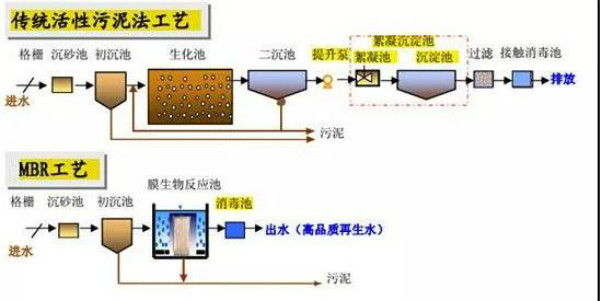
MBR Process and the Conventional Activated Sludge Process Compared with conventional wastewater treatment technologies, MBR technology has five major advantages: 1) Excellent effluent quality: MBR technology produces effluent of excellent and stable quality, with suspended solids and turbidity close to zero. It has certain advantages over conventional processes in the removal of refractory organic matter, disinfection, and ecological stability; 2) Small footprint: A high concentration of microorganisms can be maintained in the MBR reactor, and the treatment device has a high volumetric loading, so the footprint is greatly reduced compared with conventional biological processes; this is also an important reason why some municipal wastewater projects currently choose MBR. 3) Strong resistance to water quality shock: thanks to the highly efficient retention of the membrane, microorganisms can be completely retained in the bioreactor, which is conducive to the retention, growth, and reproduction of slow-growing microorganisms in the reactor, thereby improving the system's resistance to water quality shock; 4) Less excess sludge: the system operates under conditions of high volumetric loading, low sludge loading, and long sludge age, resulting in a low sludge yield and reduced sludge treatment costs; 5) Easy start-up: the system creates growth conditions for the retention and reproduction of various microorganisms, enriches the microbial community in the reactor, and shortens the acclimation period, so that the MBR can be started up and operated in a short time. Comparison of the Advantages and Disadvantages of MBR Technology and the Activated Sludge Process 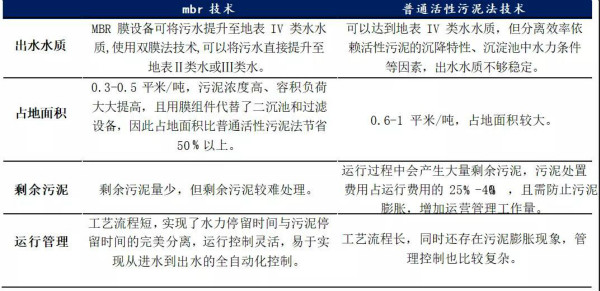
However, in the course of promotion and application, MBR technology also faces challenges such as high energy consumption, high cost, high management requirements, and difficulty in treating excess sludge. From an economic perspective, MBR technology has relatively high investment costs. According to statistics, the average total investment per tonne of water for all municipal wastewater treatment plants is about RMB 2,200, while the total investment per tonne of water for MBR is RMB 2,100-7,000, averaging about RMB 3,800, with direct engineering costs of RMB 2,000-4,500 (including civil works, installation, membrane systems, and equipment). The differences in investment cost are closely related to the application field, project construction period, membrane module manufacturer, structural form, and other factors. By comparing three wastewater treatment plants of the same region, period, and scale but with different technical routes—using the MBR process (process A), secondary biological treatment + cloth filter (process B), and secondary biological treatment + UF (process C), respectively—it can be seen that MBR has slightly lower civil engineering costs but higher membrane module investment and slightly higher investment in other supporting equipment. However, considering that MBR technology produces better effluent quality and involves lower land acquisition costs, the gap in investment cost between MBR technology and conventional technology will narrow significantly. In terms of operating cost, the direct operating cost of the MBR process is RMB 0.5-0.9/m3, about RMB 0.15/m3 higher than that of conventional processes; with membrane depreciation added, it is higher by RMB 0.4/m3, showing that MBR technology has relatively high energy consumption and operating costs. In the future, as water quality requirements continue to rise, technologies and processes continue to mature and improve, and membrane manufacturing costs continue to fall, the application share of membrane-based water treatment is expected to increase further. 05 Growth Paths of Membrane Enterprises Mergers and acquisitions are an inevitable path for the growth of international environmental giants, and this is particularly evident in the global membrane-based water treatment market. Internationally renowned membrane manufacturers are mostly diversified large enterprises, and the membrane business is only one division under their diversification strategy. Major companies expand their business into water treatment or membrane manufacturing, and then acquire existing companies and businesses to gain market share and complement their product categories and technologies. Because China's membrane industry started relatively late and is at a different stage of development from overseas, membrane enterprises are generally small in scale. The technology of China's membrane enterprises mostly comes from independent research and development by returned overseas students, the commercialization of research results from universities, research institutes, and laboratories, or the introduction of mature external technologies. In 2001 the state introduced policies for membrane industrialization; the development of the membrane industry was accompanied by an explosion in environmental engineering, and start-ups in membrane materials and systems entered the fields of environmental engineering and operations by extending along the industrial chain. Drawing on overseas development experience, China's membrane enterprises still have considerable room for improvement in production processes and materials research and development, and will need to maintain sustained R&D investment in the future. Large chemical enterprises, however, have inherent advantages in carrying out R&D on high-end membrane materials: ◆ In 2019 Wanhua Chemical invested RMB 510 million to establish a membrane plant project in the Wanhua Industrial Park, with a total production capacity of 6.19 million m2/year, of which RO membranes: 3 million m2/year; NF membranes: 600,000 m2/year; UF membranes: 500,000 m2/year; hollow fiber membranes: 1 million m2/year; MF membranes: 1 million m2/year; and modified separation membranes: 90,000 m2/year. ◆ SinoChem International has invested about RMB 970 million to build a reverse osmosis membrane plant with an annual output of 220,000 units in the Xiangshan Economic Development Zone, Ningbo. The project is expected to go into production at the end of this year or next year. The domestic market space for membrane materials is relatively small. If domestic membrane manufacturers cannot grow stronger through extension along the industrial chain, break through their own market capitalization bottlenecks, and continuously invest in R&D to build a moat, their current leading technological advantages may be at risk of being overtaken in the future, and in the long run they may hardly escape the fate of being acquired and consolidated by large groups such as Wanhua and SinoChem. Comparison of Major Domestic Listed Membrane Companies 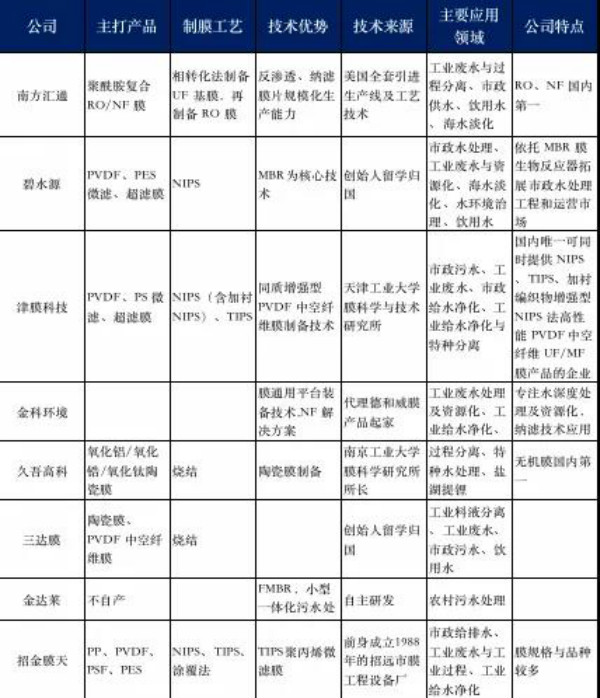
The domestic market space for membrane elements is relatively small, and enterprises that only produce upstream membrane materials will face a low market capitalization ceiling. To grow stronger, membrane enterprises need to expand from elements and systems into engineering and operations; only by extending into broader application markets can they break through the market capitalization ceiling. Therefore, the core competitiveness of membrane enterprises lies in having both technological advantages in the manufacture or integration of system equipment and engineering experience and operational capabilities; only in this way can they sustain R&D innovation, expand into new application and business areas, and continuously break through their market capitalization ceilings. References: wind; China Industry Information Network; Fundamentals of the Application of Membrane Separation Materials; Research Report on the Sustainable Development Strategy of China's Water Treatment Industry; Examples of Modern Membrane Technology and Membrane-Making Processes
|